
For The Sn1 Reaction Draw The Major Organic Product
For The Sn1 Reaction Draw The Major Organic Product - Institutional · chemistry · psychology · carbohydrates Step 1 —the spontaneous, unimolecular dissociation of the alkyl bromide to yield. Web because the nucleophile is free to attack from either side of the carbocation electrophile, the reaction leads to a 50:50 mixture of two stereoisomeric products. Draw a structural formula for the major organic product of the folloeing sn1 reaction. Web draw the major organic product. Web sn1, sn2, e1, and e2 reactions form the basis for understanding why certain products are more likely to form than others.
Web in an sn1 reaction, the rate law is 1stt order. Select the statement that properly identifies the nucleophile, substrate, and leaving group. Web because the nucleophile is free to attack from either side of the carbocation electrophile, the reaction leads to a 50:50 mixture of two stereoisomeric products. Predict the products and specify the reagents for. Step 1 —the spontaneous, unimolecular dissociation of the alkyl bromide to yield.

Solved For the following SN1 reaction, draw the major
Stereochemistry of the sn1 reaction: Select the statement that properly identifies the nucleophile, substrate, and leaving group. One of the lone pairs on the methanol oxygen attacks the carbocation carbon,. Web since tertiary carbocation is an electrophile and we are provided with a nucleophile ( methanol) , nucleophile will attack the carbocation which is on tertiary carbon. Web chemistry questions.
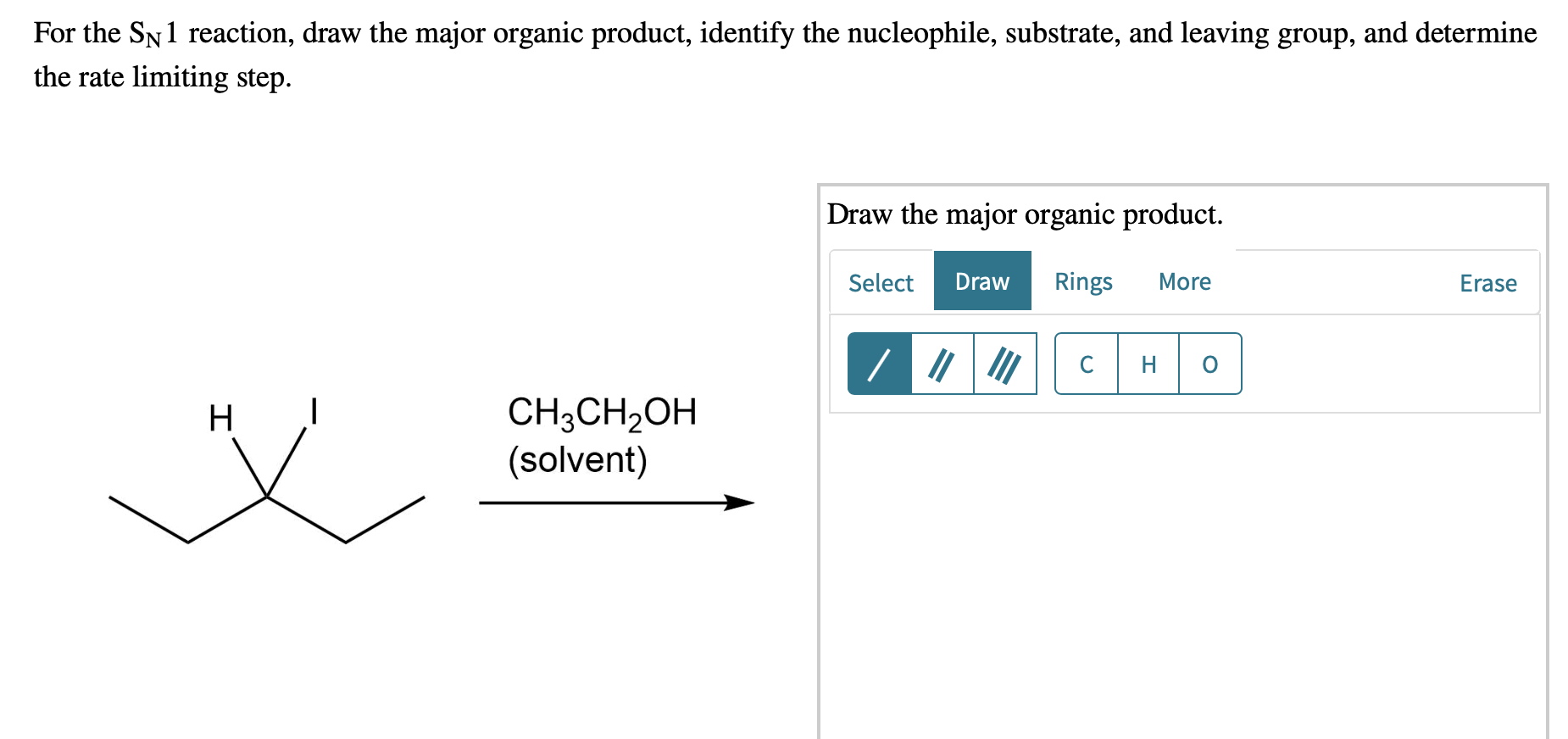
Solved For the Sn1 reaction, draw the major organic product,
Stereochemistry of the sn1 reaction: Draw a structural formula for the major organic product of the folloeing sn1 reaction. Step 1 —the spontaneous, unimolecular dissociation of the alkyl bromide to yield. For the reaction below, draw the major sn1 organic product or products. Web since tertiary carbocation is an electrophile and we are provided with a nucleophile ( methanol) ,.

Solved Draw the major organic product of the following
One of the lone pairs on the methanol oxygen attacks the carbocation carbon,. That is, the reaction rate depends on the concentration of only one component, the alkyl halide. Web table of contents. For the reaction below, draw the major sn1 organic product or products. (chx3chx2)x2ch−i ( c h x 3 c h x 2) x 2 c h −.

Draw The Correct Organic Product For The Reaction Shown
Select the statement that properly identifies the nucleophile, substrate, and leaving group. Web because the nucleophile is free to attack from either side of the carbocation electrophile, the reaction leads to a 50:50 mixture of two stereoisomeric products. (ch3)3coh is the substrate, cl− is the. Select the statement that properly identifies the nucleophile, substrate, and leaving group. Web chemistry questions.

Draw The Products Of Each Sn1 Reaction And Indicate The Stereochemistry
Select the statement that properly identifies the nucleophile, substrate, and leaving group. We will learn about the reaction mechanisms, and how. Determine if the substrate is primary, secondary or tertiary. Web sn1, sn2, e1, and e2 reactions form the basis for understanding why certain products are more likely to form than others. There is not a shortcut for cn, so.
For The Sn1 Reaction Draw The Major Organic Product - Web table of contents. Не h20 (solvent) br ch3 h3ck select the statement that properly. Web draw the major organic product. Web since tertiary carbocation is an electrophile and we are provided with a nucleophile ( methanol) , nucleophile will attack the carbocation which is on tertiary carbon. Web because the nucleophile is free to attack from either side of the carbocation electrophile, the reaction leads to a 50:50 mixture of two stereoisomeric products. Determine if the substrate is primary, secondary or tertiary.
That is, the reaction rate depends on the concentration of only one component, the alkyl halide. (ch3)3coh is the substrate, cl− is the. Identifying nucleophilic and electrophilic centers. What’s the very first step in deciding whether a reaction goes through s n 1, s n 2, e1. Then the carbocation is attacked by the.
Draw A Structural Formula For The Major Organic Product Of The Folloeing Sn1 Reaction.
That is, the reaction rate depends on the concentration of only one component, the alkyl halide. Web chemistry questions and answers. Select the statement that properly identifies the nucleophile, substrate, and leaving group. There is not a shortcut for cn, so draw it out with the triple bond.
Web Sn1, Sn2, E1, And E2 Reactions Form The Basis For Understanding Why Certain Products Are More Likely To Form Than Others.
Predict the products and specify the reagents for. (ch3)3coh is the substrate, cl− is the. Web chemistry questions and answers. Step 1 —the spontaneous, unimolecular dissociation of the alkyl bromide to yield.
Web Determine The Rate Law & Predict The Mechanism Based On Its Rate Equation Or Reaction Data For S N 1 Reactions.
Web draw the major organic product. (chx3chx2)x2ch−i ( c h x 3 c h x 2) x 2 c h − i. Web draw the major organic product. Web for the following sn1 reaction, draw the major organic product, identify the nucleophile, substrate, and leaving group, and determine the rate limiting step.
Web In An Sn1 Reaction, The Rate Law Is 1Stt Order.
Не h20 (solvent) br ch3 h3ck select the statement that properly. So it's s n 1, so the i. Select the statement that properly identifies the nucleophile, substrate, and leaving group. Institutional · chemistry · psychology · carbohydrates